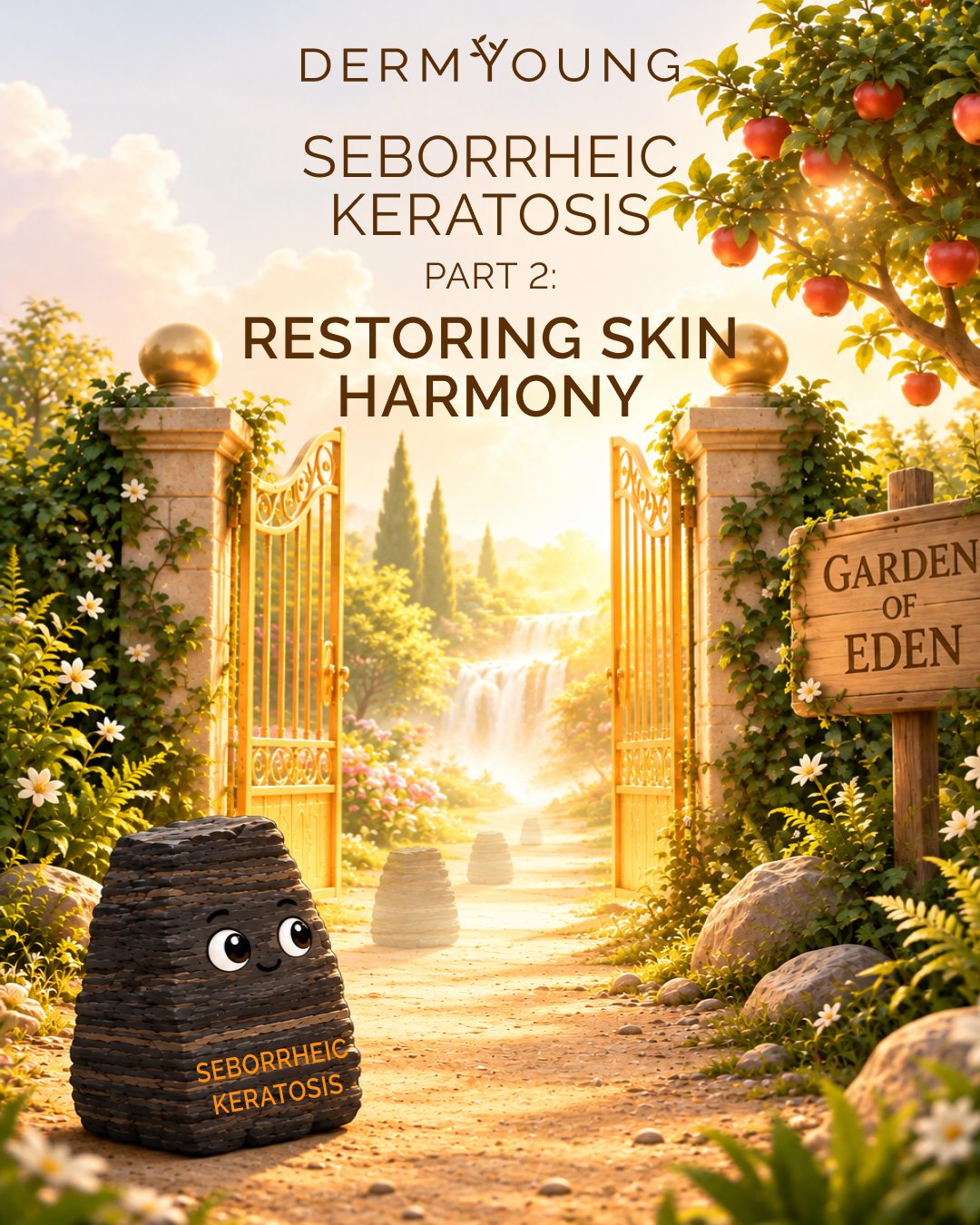
Seborrheic keratosis (SK) is defined as a benign outgrowth of the epidermis.
As an outgrowth, SK grows beyond the normal architecture of the epidermis. Yet as a benign condition, its growth remains limited—it does not continue unchecked like a malignant tumor.
So how can SK embody these two seemingly opposing forces—excessive growth and growth restraint—at the same time?
The answer may lie in the remarkable checks and balances built into our skin.
Over a lifetime, our skin accumulates molecular changes. UV radiation can damage DNA, and genomic studies of SK have identified characteristic UV-associated mutational signatures, along with mutations in growth-promoting genes such as FGFR3 and PIK3CA.
These changes can push epidermal cells toward excessive proliferation.
But growth is only half the story.
The epidermis constantly balances proliferation with differentiation. Cells are instructed not only when to grow, but also when to mature, differentiate and eventually leave the epidermis.
In SK, growth-promoting signals may have changed, while important mechanisms that restrain unlimited growth remain at work.
The accelerator is pressed.
But the brakes are still working.
Or, in the language of our Garden:
The seed has changed.
But the soil is still keeping it in check.
And, as we established in Part 1, people really want SKs gone.
Doctors freeze them, burn them, scrape them or cut them off. The internet gets even more creative. 😏
These approaches can effectively remove the SK that’s already there.
But removing one rock doesn’t change the soil.
Aging and sun-exposed skin carries a lifetime of accumulated molecular changes, and new SKs can continue to develop independently over time.
So what can we do?
The second image shows one of the cases that made us think differently.
This dermatologist-confirmed SK gradually diminished following application of DermYoung Youth Essence®. Application was discontinued.
At the one-year follow-up, the lesion remained absent.
No freezing.
No burning.
No scraping.
Just an observation that left us with a very interesting question:
What changed?
We have our thoughts.
For now, we’ll leave you with this:
Skin is not simply a surface. It is a living system constantly negotiating between growth and differentiation, damage and repair, accumulation and renewal.
Sometimes, perhaps, the most interesting approach isn’t simply to remove the rock.
It’s to understand the soil.
Restoring Skin Harmony.