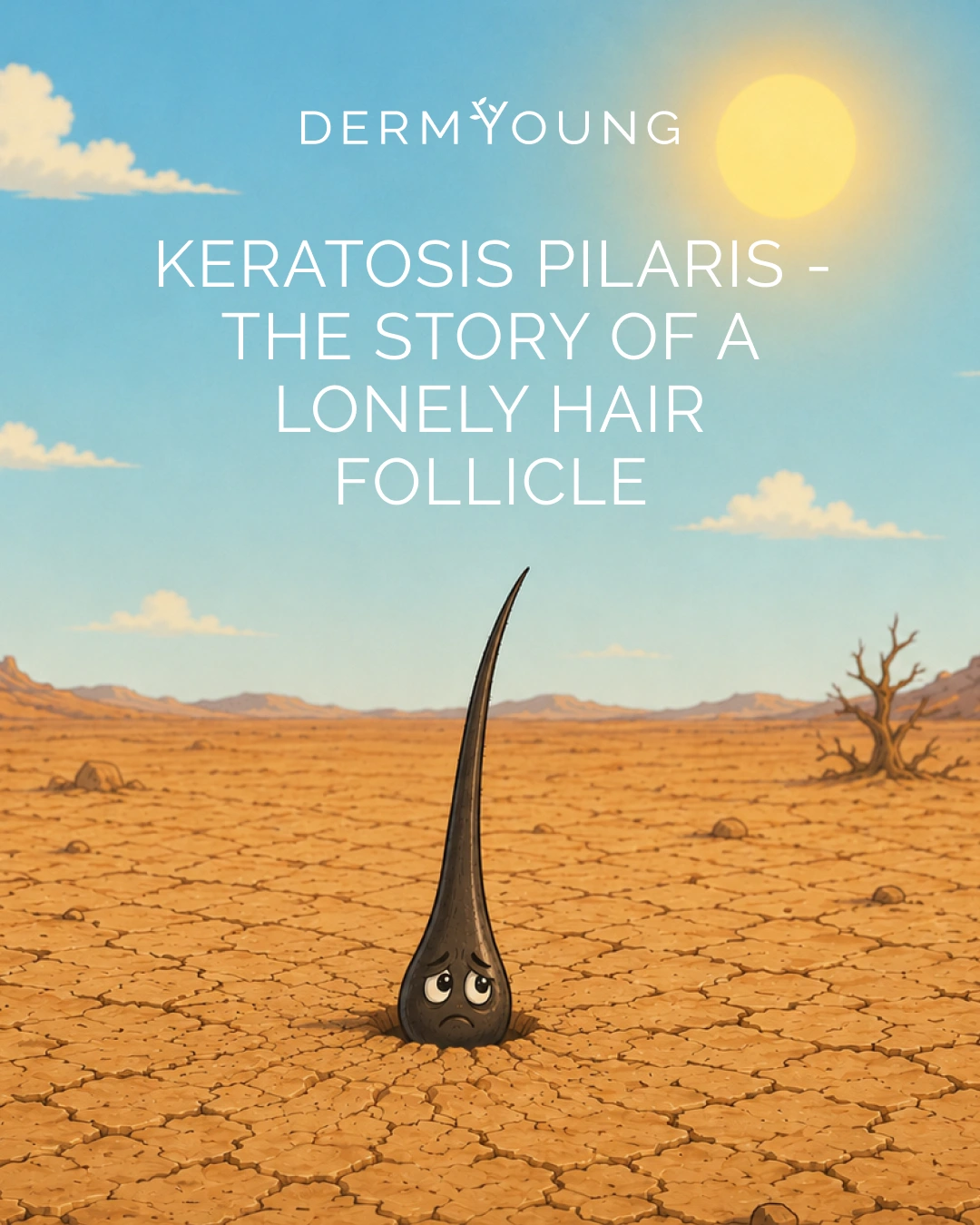
For years, keratosis pilaris (KP)—often colloquially called “chicken skin”—has been explained in almost identical, clinical terms: “Keratin plugs the hair follicles.” Technically, this definition of follicular hyperkeratosisis correct. But it is not nearly the full story.
When we look closely at what causes keratosis pilaris, the focus is almost always on the bump itself. But at DermYoung, we became interested in something else entirely: the micro-environment surrounding that bump.
The Environmental Patterns of KP and Eczema
If you look at where KP consistently appears, it is almost always in some of the driest, least sebaceous (oil-producing) regions of the body:
- The outer upper arms
- The thighs
- The buttocks
It is also remarkably common in individuals dealing with atopic dermatitis (eczema) and chronic skin barrier dysfunction. That genetic and biological overlap feels too consistent to ignore.
When we shift our focus away from the visible keratin plug, a much larger biological picture begins to emerge—one defined by chronic dryness, barrier disruption, low-grade inflammation, and dysregulated epidermal differentiation.
Is Keratosis Pilaris a Malfunction or an Adaptation?
What if the hair follicle is not simply malfunctioning? Perhaps it is adapting.
A hair follicle living in a chronically dry, inflamed, under-supported environment may gradually surround itself with compact keratin as a protective response. In an attempt to shield itself from environmental stress, protection slowly becomes obstruction.
This perspective on KP pathogenesis becomes even more compelling when we look at the dermatological literature regarding aquaporin-3 (AQP3). AQP3 is a crucial transport protein responsible for moving water and glycerol within the epidermis.
Scientific studies have firmly linked altered AQP3 expression in eczema-prone skin to three distinct issues:
1 Transepidermal water loss (severe dryness)
2 Sustained skin inflammation
3 Dysregulated suprabasal epidermal differentiation
Individually, these observations may seem like isolated cosmetic events. Together, they reveal a deeply connected ecosystem.
Could the frequent overlap between eczema and KP reflect a deeper disturbance in epidermal homeostasis? Could chronic dryness and altered skin barrier signaling gradually change how our follicles behave?
At this stage, these are questions rather than definitive clinical conclusions. But scientific progress always begins by noticing the hidden patterns that belong together.
A New Era of Keratosis Pilaris Treatment
Interestingly, modern keratosis pilaris management has already begun shifting in this direction. For decades, traditional KP treatments relied heavily on aggressive physical scrubbing and harsh chemical exfoliation to tear down surface keratin.
Today, advanced dermatological approaches emphasize a more nurturing framework:
- Deep Cellular Hydration: Flooding the moisture-depleted follicular environment.
- Skin Barrier Repair: Restoring the lipid matrix to halt underlying stress signals.
- Calming Low-Grade Inflammation: Soothing the irritation that triggers keratin overproduction.
Perhaps that evolution reflects something vital. Perhaps the follicle was never the enemy.
The DermYoung Philosophy: Supporting the Skin Ecosystem
This perspective has quietly shaped the way we formulate products and think about skin health at DermYoung for years. We don’t view the skin as something to constantly fight, overcorrect, or overwhelm with aggressive stripping agents. We see it as a living, breathing ecosystem that performs beautifully when it is properly supported.
Because sometimes, your skin is not betraying you. Sometimes, it is just trying to survive.
Beauty is a side effect of healthy skin.
How to Treat the Root Cause of KP
Are you ready to transform your skin from survival mode to thriving homeostasis? Explore our RevivOil for Body meticulously formulated to repair the skin barrier, target chronic dryness, and soothe the follicular environment without aggressive irritation.